How GeoGotar Trackers Can Be Used in Construction
Construction sites are dynamic environments where workers, vehicles, and heavy equipment move constantly. Safety conditions can change every minute, especially when multiple machines, subcontractors, and active work zones are operating at the same time.
GeoGotar helps construction teams bring precision positioning and real-time situational awareness into the field. Using RTK-enabled trackers, geofence logic, and platform-based monitoring, the system can help teams understand where workers and equipment are, whether assets are entering restricted areas, and when collision risk is increasing.
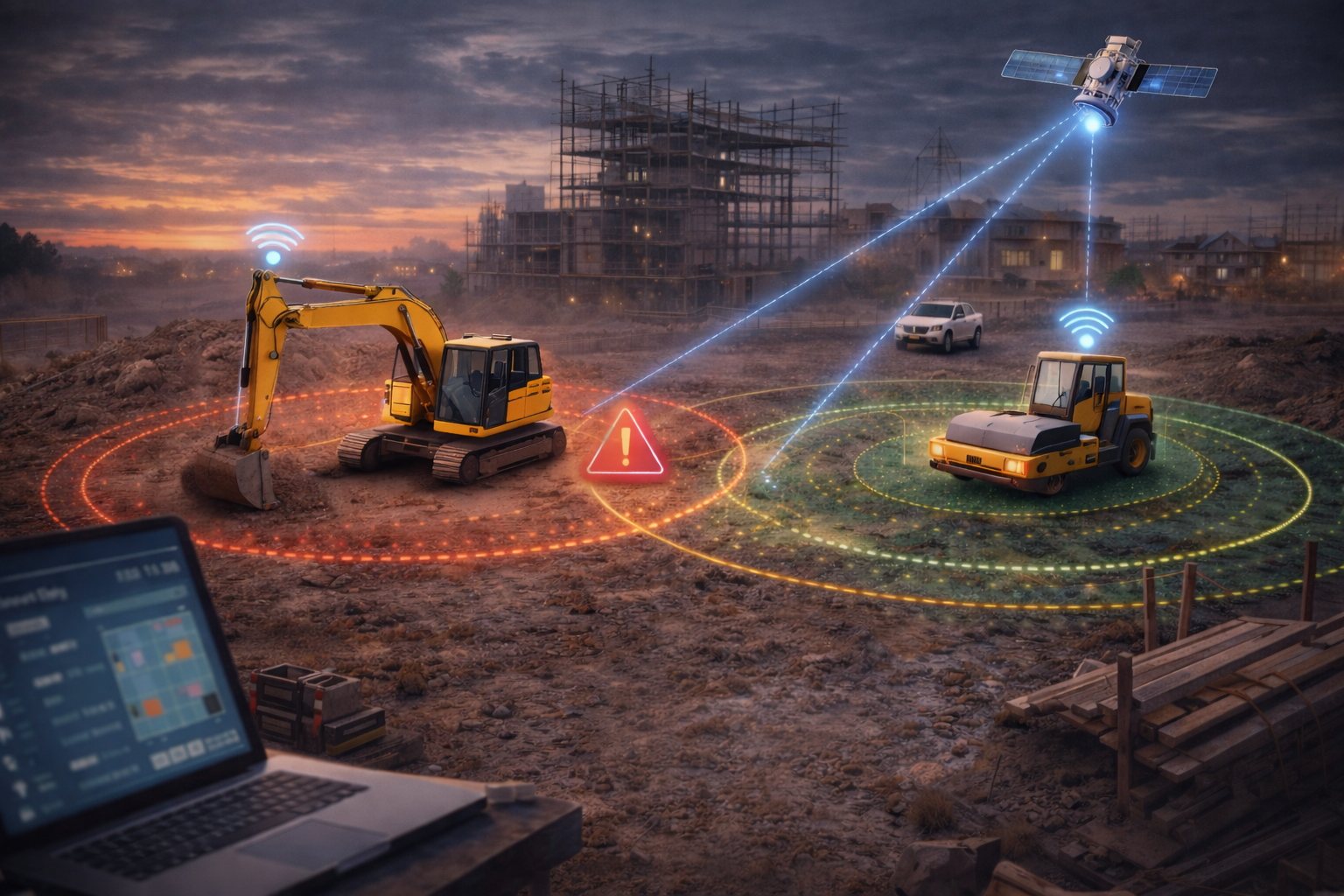
Track Workers, Vehicles, and Heavy Equipment With RTK Precision
Traditional GPS is often not accurate enough for high-risk construction workflows. GeoGotar uses RTK-enhanced positioning to deliver much higher location accuracy, which makes it more suitable for construction zones where decisions depend on exact position.
A GeoGotar tracker can be assigned to an excavator, bulldozer, asphalt roller, truck, site supervisor, or worker. Once assigned, the platform can show live location, movement history, current status, and active rules associated with that tracked entity.
Construction Use Cases
- Track excavators, rollers, trucks, and other heavy equipment across active job sites.
- Monitor worker location in relation to moving machinery.
- Detect entry into hazard zones, no-go areas, or restricted perimeters.
- Prevent equipment-to-worker and equipment-to-equipment collisions.
- Control access to sensitive or dangerous areas.
- Review movement history and field activity for reporting or investigation.
Geofencing for Construction Safety
GeoGotar supports both static and dynamic geofences for construction operations. Static zones can be used to define excavation boundaries, danger zones, restricted access areas, staging areas, or equipment corridors. Dynamic safety zones can move together with vehicles, equipment, or personnel.
This allows the system to evaluate not only whether someone entered a fixed area, but also whether two active safety zones are beginning to overlap. That is particularly useful for blind-spot detection, machine approach warnings, and worker protection near moving equipment.
Collision Prevention on Active Job Sites
One of the most important construction applications of GeoGotar is proactive collision prevention. Each device can maintain a safety perimeter around its assigned machine or worker. When those safety zones begin to intersect, the system can trigger alerts before a dangerous event occurs.
Alerts can be displayed on field devices, triggered directly on the tracker, or surfaced in the platform for supervisors and operators. This helps teams move from reactive incident response to proactive hazard prevention.
Offline-Capable Safety Logic
Construction projects often include areas with unstable connectivity. GeoGotar is designed to support offline-capable field logic, meaning devices can continue evaluating geofence and safety rules locally even if cloud connectivity is temporarily unavailable.
That makes the system more practical for remote sites, large infrastructure projects, and partially connected environments where consistent real-time communication cannot always be guaranteed.
Remote Configuration for Site Changes
Construction sites evolve quickly. New restricted areas appear, work zones move, and equipment assignments change. GeoGotar allows administrators to update device settings, zone assignments, and safety logic remotely through the platform.
This reduces the need to physically reconfigure each tracker and helps ensure that field devices stay aligned with the current site plan.
Why GeoGotar Works for Construction Teams
GeoGotar is not just a tracker. It is a construction operations platform that combines high-accuracy positioning, on-device intelligence, remote configuration, and cloud integration. This gives construction teams a practical way to improve safety, visibility, and operational control on complex job sites.
Key Benefits for Construction
- Improve worker safety near heavy equipment.
- Increase visibility across active construction zones.
- Reduce collision risk and blind-spot incidents.
- Track site equipment with higher positional accuracy.
- Support real-time alerts and offline-capable safety rules.
- Adapt faster to changing site conditions through remote configuration.