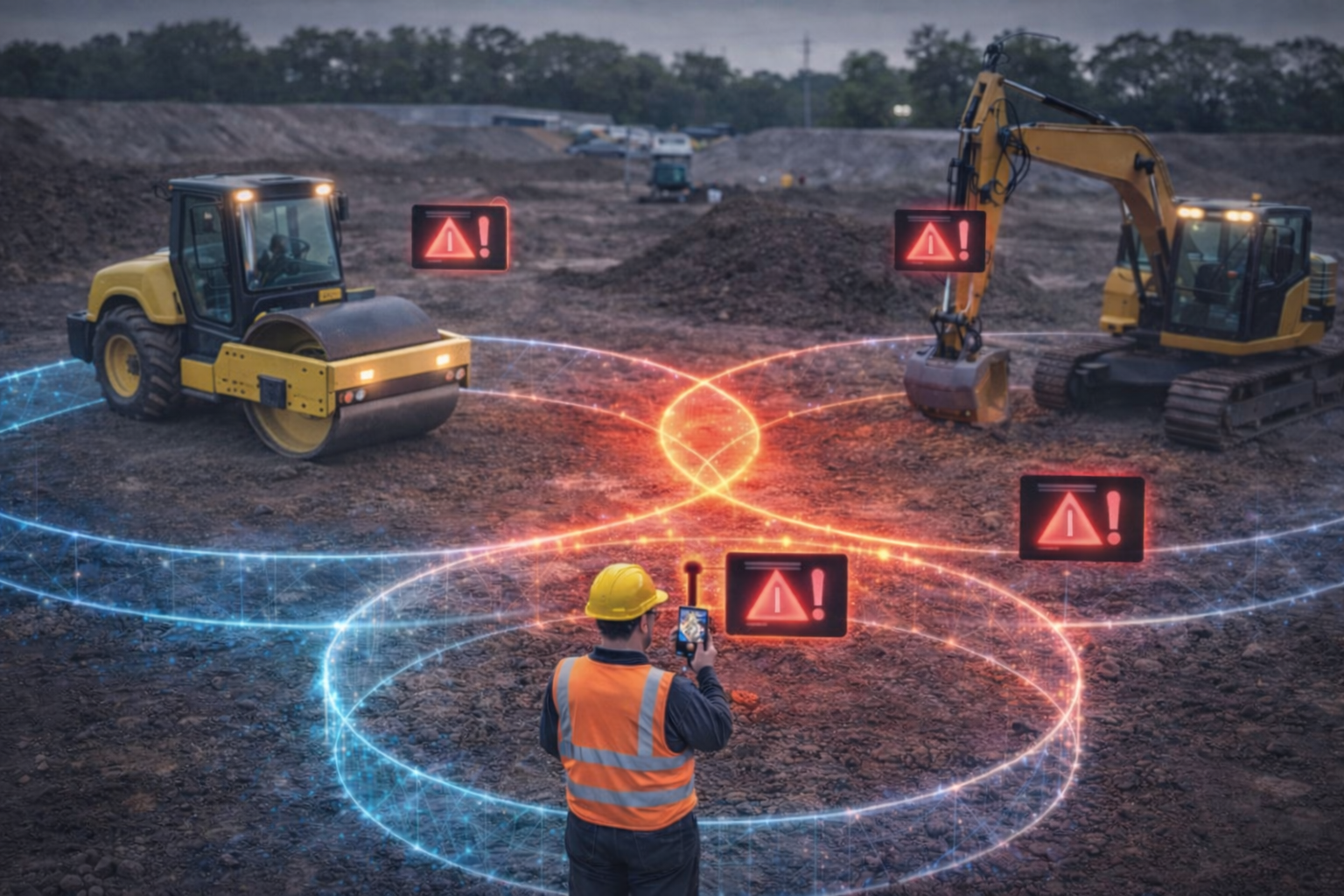
How GeoGotar Prevents Collisions in Real Time
GeoGotar combines centimeter-level RTK positioning with intelligent proximity analysis to help prevent dangerous interactions between vehicles, equipment, and personnel on active job sites.
Every GeoGotar device continuously reports its precise location and movement. The platform dynamically calculates the distance between all active objects — machines, vehicles, and workers — and evaluates potential risk scenarios in real time.
Unlike traditional safety systems that rely only on static geofences, GeoGotar creates dynamic safety zones that move together with each asset or person. These zones act as configurable safety buffers around equipment and personnel.
When two safety zones begin to overlap, the system instantly detects a potential collision risk and generates warnings before the situation escalates into an incident.
GeoGotar can respond in real time by:
- Triggering visual alerts on mobile devices.
- Sending warnings to equipment operators.
- Activating on-device alarms or vibration signals.
- Notifying supervisors through the platform interface.
This allows operators and workers to react before a dangerous situation becomes a collision, near miss, or injury event.
Built for Construction, Road Work, and Heavy Equipment Operations
The system is designed for environments where site conditions change constantly — construction zones, road work projects, industrial facilities, mining operations, and other heavy-equipment environments where visibility and proximity risk are critical.
Because GeoGotar supports offline-capable safety logic, critical geofence and proximity detection can continue even when network connectivity is limited or unavailable. Devices can perform local checks and deliver alerts directly in the field.
Once connectivity is restored, event data and telemetry are synchronized back to the platform for analysis, reporting, compliance review, and operational insight.
Key Benefits of the GeoGotar Collision Prevention Platform
- Reduce vehicle-to-worker and vehicle-to-vehicle collision risks.
- Improve situational awareness on active job sites.
- Protect workers, equipment, and site operations.
- Support safer and more efficient field workflows.
- Enable RTK-accurate alerts even in low-connectivity environments.
Other use cases:
- Heavy Equipment Proximity Alerts
- Offline Geofence and Safety Logic